
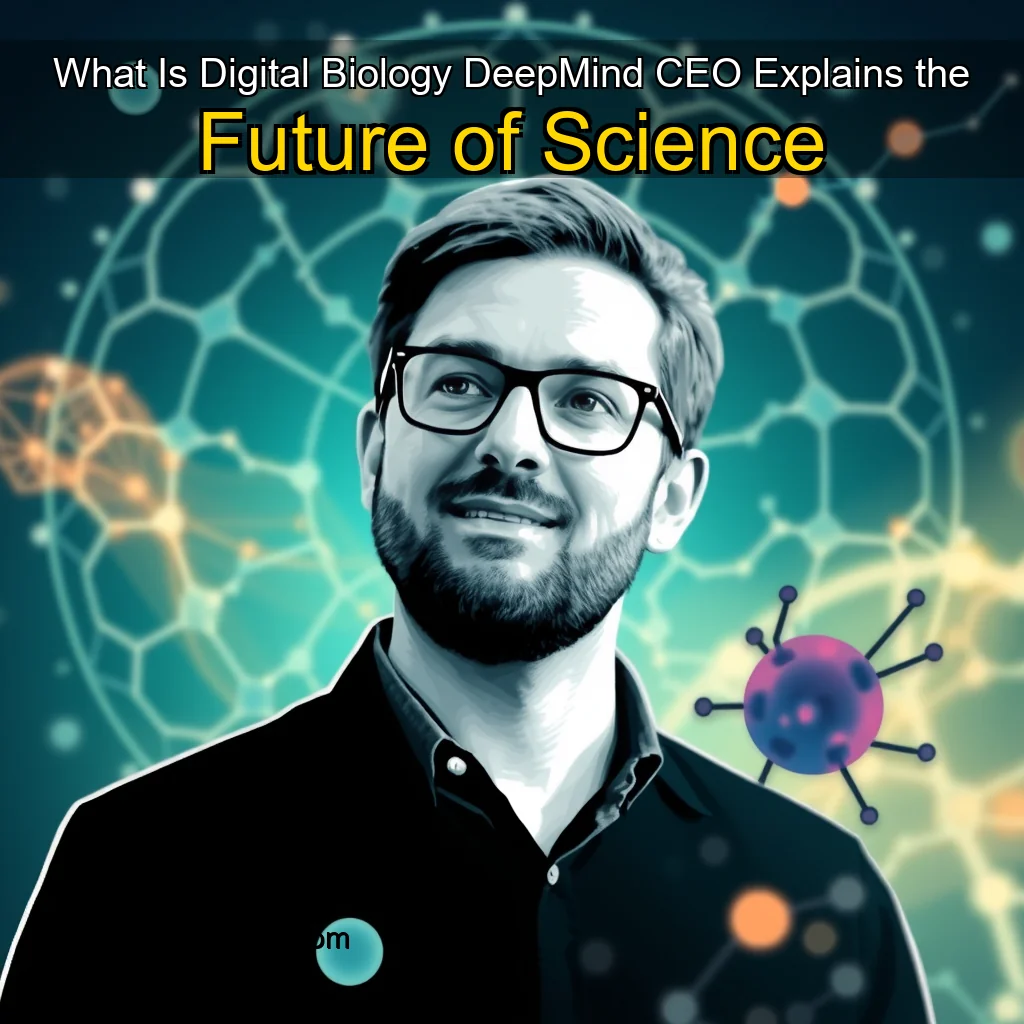
The Dawn of Digital Biology
The concept of digital biology is a rapidly evolving field that seeks to harness the power of artificial intelligence and machine learning to understand and manipulate the fundamental building blocks of life. At the forefront of this revolution is a leading executive at DeepMind, who is predicting a seismic shift in the way we approach science and innovation.
The Promise of Digital Biology
Digital biology has the potential to unlock new breakthroughs in protein folding, quantum computing, and other areas of research. By leveraging the power of AI and machine learning, scientists can gain a deeper understanding of the complex interactions between molecules and cells, leading to new insights and discoveries.
The Power of AI in Digital Biology
In the realm of digital biology, artificial intelligence (AI) plays a pivotal role in deciphering the intricacies of biological systems. By treating biological systems as complex information-processing frameworks, AI enables researchers to analyze and understand the intricate mechanisms that govern life. This approach has far-reaching implications for various fields, including medicine, agriculture, and biotechnology.
The Role of AI in Protein Folding Research
One of the most significant applications of AI in digital biology is protein folding research. Proteins are the building blocks of life, and their three-dimensional structures determine their functions.
By leveraging machine learning algorithms, researchers can analyze vast amounts of data, identify patterns, and make predictions about the efficacy of potential drugs. This can lead to the development of more effective treatments for a wide range of diseases.
The Power of AlphaFold: Unlocking the Secrets of Molecular Biology
A New Era in Drug Development
The success of AlphaFold has opened up new avenues for drug development, revolutionizing the way researchers approach this complex process. By harnessing the power of AI, scientists can now identify promising drug candidates more efficiently, reducing the time and resources required to bring new treatments to market. Key benefits of AI in drug development: + Reduced time to identify promising drug candidates + Improved accuracy in predicting drug efficacy + Enhanced ability to analyze vast amounts of data + Increased efficiency in the drug development process
Unlocking the Secrets of Molecular Biology
AlphaFold’s success demonstrates the potential of AI to bridge knowledge gaps in molecular biology. By analyzing vast amounts of data, machine learning algorithms can identify patterns and make predictions about the behavior of molecules. This can lead to a deeper understanding of the underlying mechanisms of biological systems, enabling researchers to develop more effective treatments for a wide range of diseases. Applications of AlphaFold in molecular biology: + Understanding protein structure and function + Identifying potential drug targets + Developing new treatments for diseases + Improving our understanding of biological systems
The Future of AI in Molecular Biology
As AlphaFold continues to advance, we can expect to see significant breakthroughs in our understanding of molecular biology.
Here are some examples of how AI is transforming biology:
AI in Biology: Unlocking New Frontiers
Understanding Complex Biological Systems
AI is being used to analyze and understand complex biological systems, such as the human brain and the microbiome. By processing large amounts of data, AI can identify patterns and relationships that may not be apparent to humans. This can lead to new insights into the functioning of these systems and the development of new treatments for diseases. Brain-Computer Interfaces: AI is being used to develop brain-computer interfaces that can read and write neural signals. This technology has the potential to revolutionize the treatment of paralysis and other neurological disorders. Microbiome Analysis: AI is being used to analyze the microbiome, which is the collection of microorganisms that live within and on the human body.
The Three Key Characteristics of AI in Science
1. High-Throughput Analysis**
AI excels in high-throughput analysis, where large amounts of data need to be processed quickly and efficiently. This is particularly useful in fields like genomics, where researchers need to analyze vast amounts of genetic data to identify patterns and make predictions. For example, in the field of cancer research, AI can be used to analyze large datasets of genomic information to identify potential cancer biomarkers. In the field of climate science, AI can be used to analyze large datasets of climate data to identify patterns and make predictions about future climate trends.*
2. Pattern Recognition**
AI is also well-suited for pattern recognition, where complex data needs to be analyzed to identify underlying patterns and relationships. This is particularly useful in fields like materials science, where researchers need to analyze large datasets of material properties to identify new materials with specific properties. For example, in the field of materials science, AI can be used to analyze large datasets of material properties to identify new materials with specific properties, such as superconductivity or nanomechanical properties. In the field of biology, AI can be used to analyze large datasets of biological data to identify patterns and relationships that can inform new treatments for diseases. Predictive Modeling** AI is also well-suited for predictive modeling, where complex systems need to be analyzed to make predictions about future outcomes. This is particularly useful in fields like finance, where researchers need to analyze large datasets of financial data to make predictions about future market trends.
Quantum computing can process vast amounts of data in parallel, making it an ideal tool for complex simulations and modeling.
The Power of Quantum Computing
Quantum computing is a rapidly evolving field that has the potential to revolutionize various industries and solve complex problems that are currently unsolvable with traditional computers. Its unique ability to process information in fundamentally different ways makes it an attractive solution for tackling problems that demand high levels of precision and adaptability.
Key Benefits of Quantum Computing
In chemistry, AI is being used to design new compounds with specific properties. In geology, AI can aid in the analysis of geological samples and the prediction of natural disasters.
AI in Materials Science
Materials science is one of the fields that is likely to be significantly impacted by AI. The integration of AI into materials science can accelerate the discovery of new materials with desirable properties. For instance, AI can be used to simulate the behavior of materials under various conditions, allowing researchers to predict their properties and potential applications.
This shift in focus enables researchers to tackle complex challenges that were previously insurmountable.
The Rise of AI in Scientific Research
The integration of AI into scientific research has been gaining momentum in recent years. This trend is driven by the increasing availability of large datasets, advances in computing power, and the development of sophisticated machine learning algorithms.
Key Drivers of AI Adoption in Science
In this era, scientists are harnessing the power of artificial intelligence to explore the intricacies of life and the universe.
The Rise of Digital Biology
The field of digital biology is rapidly evolving, driven by advances in artificial intelligence, machine learning, and high-performance computing.

news is a contributor at Soozo. We are committed to providing well-researched, accurate, and valuable content to our readers.