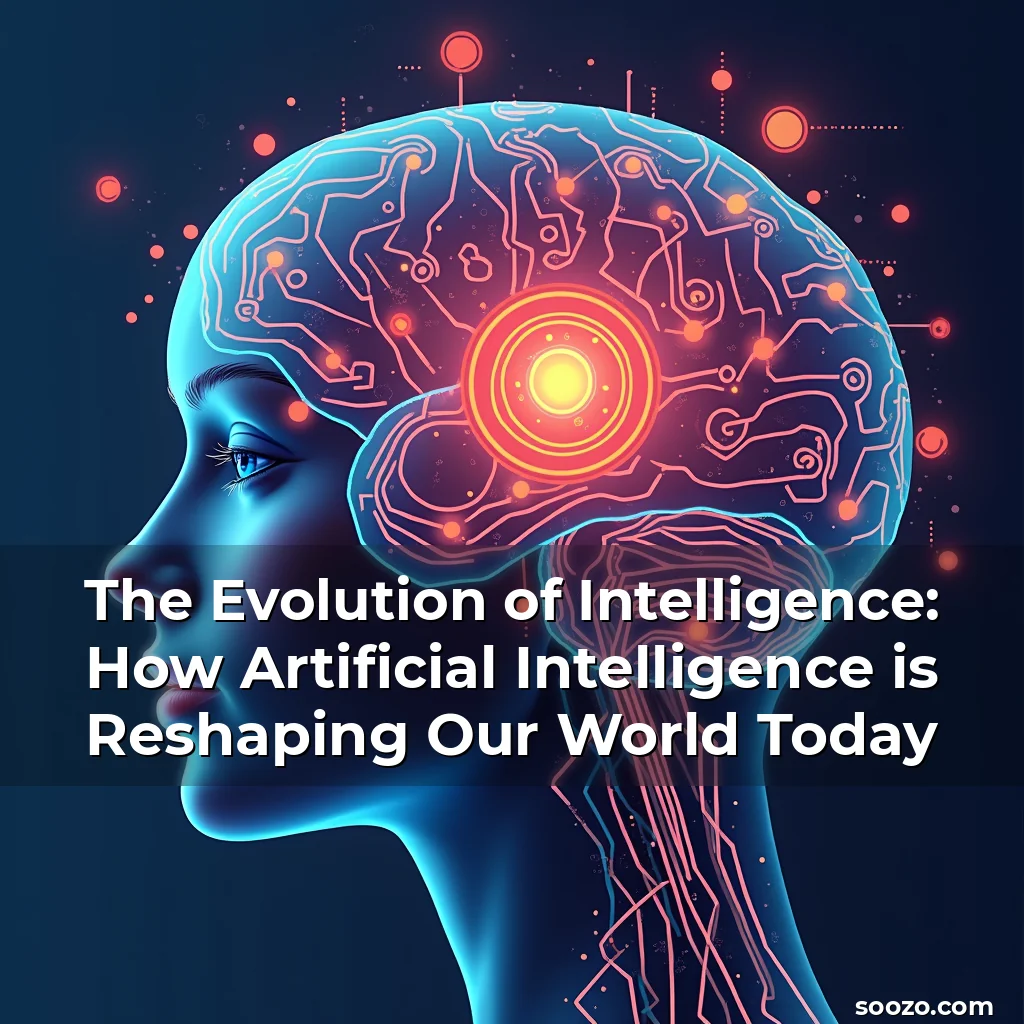
The Evolution of Intelligence: How Artificial Intelligence is Reshaping Our World Today
In an era where technology moves at lightning speed, artificial intelligence has emerged as one of the most transformative forces shaping our daily lives. From personalized recommendations on streaming platforms to autonomous vehicles navigating complex city streets, AI’s influence extends far beyond what many realize.
This groundbreaking field combines computer science, mathematics, and cognitive psychology to create systems that can learn, reason, and even mimic human decision-making processes. As we delve deeper into the world of AI, we uncover its vast potential to revolutionize industries and redefine how humans interact with machines.
The Foundations of Artificial Intelligence
Artificial intelligence traces its roots back to ancient philosophical inquiries about the nature of thought itself. Early thinkers pondered whether machines could be programmed to think logically, setting the stage for centuries of scientific exploration.
Modern AI development began in earnest during the mid-20th century when researchers started building computational models capable of mimicking basic human cognition. This foundational period laid the groundwork for today’s sophisticated machine learning algorithms.
- Symbolic AI: Focuses on rule-based logic and knowledge representation through formal symbols
- Machine Learning: Uses statistical patterns from data to make predictions without explicit programming
- Neural Networks: Mimics biological neurons to recognize complex patterns in unstructured data
These three pillars form the bedrock upon which contemporary AI systems are built. Symbolic approaches provide structured reasoning while neural networks enable pattern recognition across diverse domains.
Researchers continue refining these techniques by integrating them with emerging fields like quantum computing and neuromorphic engineering. Such innovations promise to push the boundaries of what AI can achieve in both capability and efficiency.
Differentiating AI Types: Narrow vs General Intelligence
Understanding the distinctions between narrow and general AI is crucial for grasping current technological capabilities versus future aspirations. These two categories represent vastly different levels of complexity and functionality.
Narrow AI refers to systems designed for specific tasks such as language translation or image recognition. These applications excel within their designated functions but lack broader comprehension abilities.
Exploring Narrow AI Applications
Virtual assistants like Siri and Alexa demonstrate how well-designed narrow AI can integrate seamlessly into everyday life. They understand natural language queries and perform actions based on user commands.
Healthcare professionals use diagnostic tools powered by AI to analyze medical images with remarkable accuracy. Studies show these systems often match or exceed human performance in identifying conditions like cancerous tumors.
Financial institutions deploy fraud detection algorithms that process billions of transactions daily. By detecting anomalies in real-time, these systems prevent fraudulent activities before they cause damage.
Each application showcases how targeted AI solutions solve concrete problems more efficiently than traditional methods ever could. The key lies in focusing AI’s power precisely where it delivers the greatest value.
The Rise of Machine Learning
Machine learning has become the driving force behind many modern AI breakthroughs. Unlike conventional software, ML systems continuously improve their performance through experience rather than relying solely on pre-programmed instructions.
This self-improving capability allows computers to detect subtle patterns in massive datasets that would be impossible for humans to discern manually. From weather forecasting to stock market analysis, ML transforms raw information into actionable insights.
Data scientists train these models using labeled examples, enabling them to generalize from known cases to new situations. Techniques like supervised learning guide models toward accurate predictions by comparing outputs against established benchmarks.
Unsupervised learning presents another powerful approach by allowing systems to discover hidden structures within unlabeled data. This method proves particularly useful for tasks like customer segmentation and anomaly detection.
Deep Learning and Neural Networks
Deep learning represents a significant leap forward in AI capabilities, primarily due to advancements in neural network architectures. These multi-layered systems emulate the way human brains process information through interconnected nodes.
The resurgence of deep learning coincided with increased availability of big data and improvements in GPU processing power. Together, these factors enabled training of much larger and more complex models than previously possible.
Convolutional neural networks have revolutionized image recognition, achieving near-human-level accuracy in object identification tasks. Recurrent networks excel at processing sequential data like text and speech signals.
Transformers, a newer architecture type, have set new standards in natural language understanding. Their attention mechanisms allow models to grasp context better than earlier sequence models ever managed.
Despite their successes, deep learning systems remain opaque in many ways. Researchers actively work on developing explainable AI frameworks to address concerns around model interpretability and trustworthiness.
Ethical Considerations in AI Development
As AI becomes increasingly integrated into society, ethical questions surrounding its deployment grow more pressing. Developers must balance innovation with responsibility to ensure technologies benefit humanity equitably.
Bias embedded in training data can lead to discriminatory outcomes, particularly affecting marginalized communities. Addressing algorithmic bias requires careful auditing of datasets and implementation of fairness-aware algorithms.
Privacy protection remains a critical concern as AI systems analyze sensitive personal information. Differential privacy techniques help safeguard individual identities while still enabling meaningful data analysis.
Transparency initiatives aim to demystify how AI decisions are made, fostering public trust through clear documentation of system limitations and assumptions.
Ongoing discussions shape evolving guidelines for responsible AI development, emphasizing principles like accountability, inclusivity, and long-term societal impact assessments.
AI in Industry Transformation
No industry remains untouched by the sweeping changes brought about by artificial intelligence. Manufacturing plants now operate with smart robotics, logistics companies optimize routes dynamically, and healthcare providers enhance diagnostics through intelligent systems.
Predictive maintenance uses sensor data analytics to anticipate equipment failures before they occur. This proactive approach significantly reduces downtime and maintenance costs across various sectors.
In retail environments, inventory management systems powered by AI adjust stocking levels automatically based on demand forecasts. These adaptive strategies minimize waste while ensuring product availability meets consumer needs.
Customer service operations benefit greatly from chatbots handling routine inquiries 24/7. Human agents then focus on resolving more complex issues requiring nuanced judgment and empathy.
Education and Workforce Adaptation
The rise of AI necessitates fundamental shifts in education curricula worldwide. Institutions must equip students with skills that complement rather than compete with automated systems.
Coding proficiency alone will not suffice; creativity, emotional intelligence, and problem-solving abilities emerge as essential competencies for tomorrow’s workforce. These uniquely human traits remain difficult to replicate technologically.
Lifelong learning programs gain increasing importance as workers need to continually update their skill sets to stay relevant. Online micro-learning platforms offer flexible opportunities for professional development at any career stage.
Governments and businesses collaborate to implement reskilling initiatives, helping displaced workers transition successfully into roles that require human oversight of AI systems.
The Future Landscape of AI
Looking ahead, several promising trends indicate where AI research might lead us next. Quantum machine learning promises exponential increases in processing speeds for certain types of computations.
Federated learning offers exciting possibilities for collaborative model training while preserving data privacy. This technique enables organizations to jointly develop AI solutions without sharing sensitive information directly.
Advances in brain-computer interfaces suggest intriguing prospects for merging biological and digital intelligence. While still in early stages, these developments could eventually enable direct communication between minds and machines.
As we stand on the precipice of these transformations, maintaining a balanced perspective remains vital. Responsible stewardship ensures that AI serves as a tool for progress rather than a source of disruption.
Conclusion
From its theoretical origins to today’s pervasive presence in nearly every aspect of modern life, artificial intelligence continues to evolve at an astonishing pace. Its journey reflects both the ingenuity of human innovation and the complexities inherent in replicating natural intelligence artificially.
To fully harness AI’s potential while mitigating risks, ongoing collaboration among developers, policymakers, and end-users becomes imperative. Embracing this technology responsibly positions us to build a future where AI enhances human capabilities rather than replacing them entirely.

news is a contributor at Soozo. We are committed to providing well-researched, accurate, and valuable content to our readers.