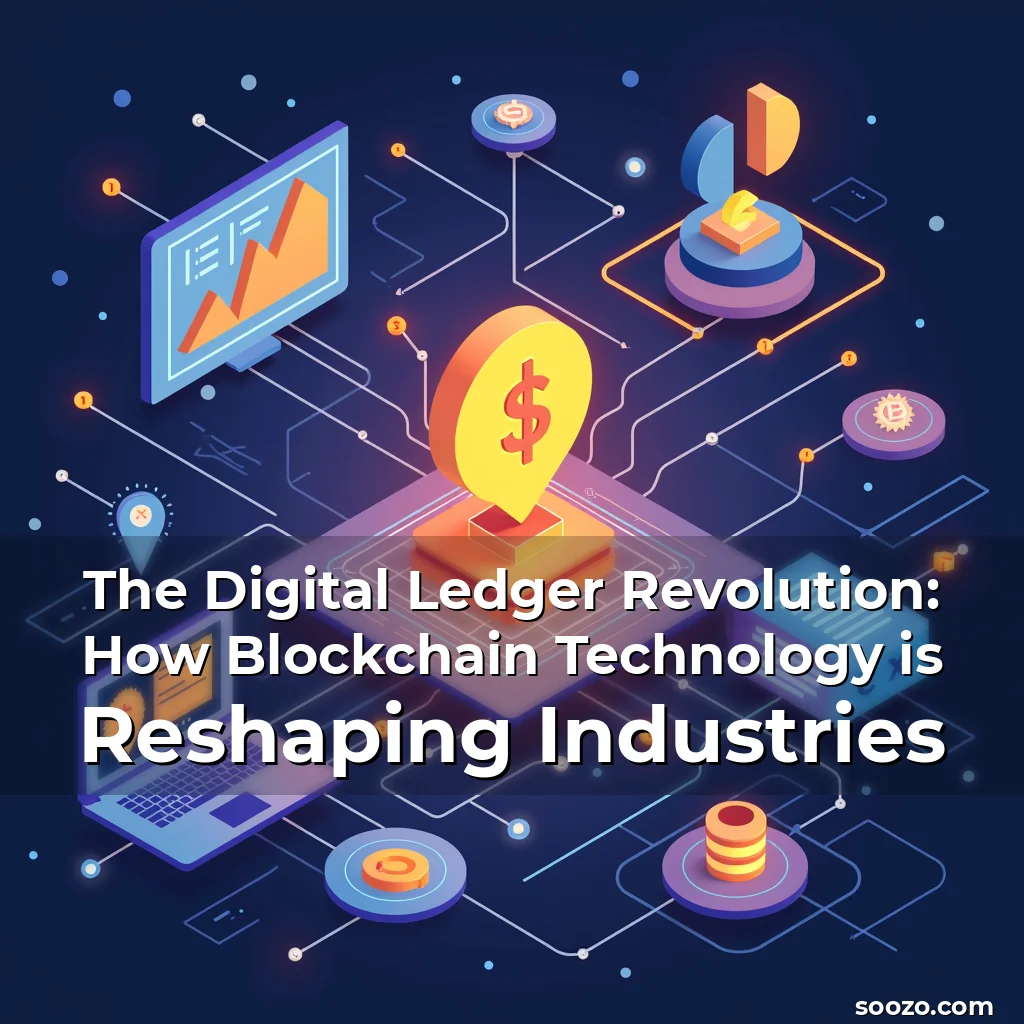
The Digital Ledger Revolution: How Blockchain Technology is Reshaping Industries
In an era where data integrity and security are paramount, blockchain technology has emerged as a revolutionary force, redefining how we store, share, and verify information. This decentralized digital ledger system offers unprecedented transparency and trust without relying on central authorities.
At its core, blockchain operates through a network of computers that collectively maintain a tamper-proof record of transactions. Its potential applications extend far beyond cryptocurrency, touching industries from healthcare to supply chain management.
Understanding the Foundations of Blockchain
Blockchain technology functions by creating a sequence of blocks linked together using cryptographic hashing techniques. Each block contains a list of transactions, timestamp, and a reference to the previous block’s hash value.
This structure ensures immutability because altering any single transaction would require recalculating the hashes of all subsequent blocks—a computationally impractical feat given modern encryption standards.
The process begins when users initiate transactions that get grouped into blocks before being verified by nodes within the network. These verifications ensure authenticity while maintaining consensus across distributed systems.
- Distributed Network: Instead of centralized servers, blockchain relies on peer-to-peer networks ensuring redundancy and eliminating single points of failure.
- Cryptographic Security: Advanced algorithms protect against unauthorized access, making data manipulation nearly impossible without detection.
Decentralization: The Heartbeat of Blockchain Innovation
One fundamental principle underpinning blockchain technology is decentralization—an architectural choice that eliminates reliance on intermediaries such as banks or governments.
By distributing control among participants rather than concentrating power in singular entities, blockchain empowers individuals with greater autonomy over their digital assets and personal information.
This model not only enhances security but also reduces costs associated with traditional verification processes often involving third-party validation fees.
Real-world Impact of Decentralized Systems
According to Deloitte’s 2023 report, organizations implementing decentralized solutions experienced up to a 40% reduction in operational costs compared to conventional methods.
Moreover, these systems enable faster cross-border payments by bypassing intermediary financial institutions which traditionally slow down international transfers.
Smart Contracts: Automating Trust Through Code
Smart contracts represent self-executing agreements written in code that automatically enforce terms between parties involved in business dealings.
These programmable contracts operate autonomously once deployed onto the blockchain platform, reducing human intervention risks while increasing efficiency in contract execution timelines.
Developers use languages like Solidity (for Ethereum) to build smart contracts capable of handling complex logic including conditional statements based upon real-time events.
- Automated Enforcement: Smart contracts execute actions instantly whenever predefined conditions are met—eliminating delays caused by manual approvals.
- Transparency & Accountability: Every action taken via smart contracts is recorded permanently on-chain allowing full traceability back to original agreement parameters.
Applications Beyond Cryptocurrency: Expanding Horizons
While Bitcoin popularized blockchain initially, recent years have seen exponential growth in diverse sectors leveraging this technology for innovative purposes.
Healthcare providers utilize secure patient records stored on blockchains enabling seamless sharing between authorized medical professionals while preserving privacy regulations compliance.
Educational institutions explore credential verification platforms built atop blockchain infrastructure verifying academic achievements quickly and reliably without needing physical documentation checks.
Supply Chain Transparency Gains Momentum
A study published in MIT Review revealed that companies adopting blockchain-based tracking mechanisms improved product recall accuracy rates by approximately 65% due to enhanced visibility along entire distribution channels.
Such implementations allow consumers to trace products’ origins—from raw materials sourcing locations right down to final assembly sites—ensuring ethical production practices adherence at every stage.
Sustainability Efforts Powered by Blockchain
Environmental concerns surrounding energy consumption related to proof-of-work protocols used primarily in early cryptocurrencies prompted exploration towards greener alternatives.
Emerging technologies such as proof-of-stake models significantly reduce electricity demands required for validating new blocks thereby addressing carbon footprint issues plaguing legacy systems.
Additionally, initiatives focused on renewable energy trading facilitate direct consumer-producer interactions through tokenized credits traded securely across global markets utilizing blockchain frameworks.
- Energy Efficiency Improvements: Transitioning away from resource-intensive mining operations toward eco-friendly consensus mechanisms helps curb environmental degradation impacts.
- Carbon Credit Management: Blockchain enables transparent accounting for emissions reductions achieved by businesses participating in voluntary climate action programs worldwide.
Challenges Facing Adoption and Integration
Despite promising developments, widespread adoption faces hurdles stemming mainly from regulatory uncertainty regarding legal status definitions across jurisdictions globally.
Varying governmental policies create confusion around permissible uses leading some enterprises hesitant about fully committing resources until clearer guidelines emerge.
Technical limitations remain another obstacle; current scalability issues prevent mass-market readiness despite ongoing research aimed at improving throughput capabilities via layer-two solutions or sharding approaches.
Regulatory Landscape Continues Evolving Dynamically
Governments worldwide grapple with defining appropriate oversight measures balancing innovation promotion alongside consumer protection needs effectively.
In response, several countries established sandboxes allowing startups test novel applications safely under controlled environments facilitating policy development informed by practical experiences gained during trials.
Fostering Inclusion Through Financial Technologies
Blockchain facilitates inclusive finance by providing unbanked populations access to essential services previously inaccessible due largely to geographical constraints or lack sufficient collateral requirements.
Mobile-first digital wallets powered by blockchain enable remittances processing efficiently even in regions lacking robust banking infrastructures contributing positively toward achieving SDGs related poverty alleviation efforts internationally.
Microfinance platforms leverage tokenization strategies offering microloans secured digitally minimizing default risks inherent within informal lending ecosystems prevalent amongst low-income communities globally.
- Financial Empowerment Tools: Individuals gain ability manage funds independently without needing traditional bank accounts promoting economic independence especially beneficial rural areas underserved conventionally.
- Transparent Lending Practices: Utilizing immutable ledgers improves accountability within credit granting procedures decreasing corruption incidents observed frequently within developing economies experiencing weak institutional frameworks.
Future Prospects and Technological Advancements
Ongoing R&D focuses heavily on enhancing interoperability features connecting disparate blockchain networks seamlessly exchanging data securely across different chains enhancing overall ecosystem utility exponentially.
Quantum computing threats prompt proactive development resilient cryptographic schemes designed withstand future advancements potentially undermining existing encryption methodologies currently relied upon extensively today.
Predictive analytics integrated with AI models analyze vast quantities structured/unstructured data identifying patterns useful optimizing various operational efficiencies applicable numerous domains ranging logistics optimization through personalized medicine recommendations tailored individual health profiles accurately.
Conclusion
Blockchain technology stands poised to revolutionize myriad aspects modern life transforming how societies interact economically socially environmentally sustainably.
To stay ahead curve, embracing continuous learning exploring emerging trends actively contributes shaping tomorrow’s technological landscape positively impacting collective well-being globally.
“`
The Digital Ledger Revolution: How Blockchain Technology is Reshaping Industries
In an era where data integrity and security are paramount, blockchain technology has emerged as a revolutionary force, redefining how we store, share, and verify information. This decentralized digital ledger system offers unprecedented transparency and trust without relying on central authorities.
At its core, blockchain operates through a network of computers that collectively maintain a tamper-proof record of transactions. Its potential applications extend far beyond cryptocurrency, touching industries from healthcare to supply chain management.
Understanding the Foundations of Blockchain
Blockchain technology functions by creating a sequence of blocks linked together using cryptographic hashing techniques. Each block contains a list of transactions, timestamp, and a reference to the previous block’s hash value.
This structure ensures immutability because altering any single transaction would require recalculating the hashes of all subsequent blocks—a computationally impractical feat given modern encryption standards.
The process begins when users initiate transactions that get grouped into blocks before being verified by nodes within the network. These verifications ensure authenticity while maintaining consensus across distributed systems.
- Distributed Network: Instead of centralized servers, blockchain relies on peer-to-peer networks ensuring redundancy and eliminating single points of failure.
- Cryptographic Security: Advanced algorithms protect against unauthorized access, making data manipulation nearly impossible without detection.
Decentralization: The Heartbeat of Blockchain Innovation
One fundamental principle underpinning blockchain technology is decentralization—an architectural choice that eliminates reliance on intermediaries such as banks or governments.
By distributing control among participants rather than concentrating power in singular entities, blockchain empowers individuals with greater autonomy over their digital assets and personal information.
This model not only enhances security but also reduces costs associated with traditional verification processes often involving third-party validation fees.
Real-world Impact of Decentralized Systems
According to Deloitte’s 2023 report, organizations implementing decentralized solutions experienced up to a 40% reduction in operational costs compared to conventional methods.
Moreover, these systems enable faster cross-border payments by bypassing intermediary financial institutions which traditionally slow down international transfers.
Smart Contracts: Automating Trust Through Code
Smart contracts represent self-executing agreements written in code that automatically enforce terms between parties involved in business dealings.
These programmable contracts operate autonomously once deployed onto the blockchain platform, reducing human intervention risks while increasing efficiency in contract execution timelines.
Developers use languages like Solidity (for Ethereum) to build smart contracts capable of handling complex logic including conditional statements based upon real-time events.
- Automated Enforcement: Smart contracts execute actions instantly whenever predefined conditions are met—eliminating delays caused by manual approvals.
- Transparency & Accountability: Every action taken via smart contracts is recorded permanently on-chain allowing full traceability back to original agreement parameters.
Applications Beyond Cryptocurrency: Expanding Horizons
While Bitcoin popularized blockchain initially, recent years have seen exponential growth in diverse sectors leveraging this technology for innovative purposes.
Healthcare providers utilize secure patient records stored on blockchains enabling seamless sharing between authorized medical professionals while preserving privacy regulations compliance.
Educational institutions explore credential verification platforms built atop blockchain infrastructure verifying academic achievements quickly and reliably without needing physical documentation checks.
Supply Chain Transparency Gains Momentum
A study published in MIT Review revealed that companies adopting blockchain-based tracking mechanisms improved product recall accuracy rates by approximately 65% due to enhanced visibility along entire distribution channels.
Such implementations allow consumers to trace products’ origins—from raw materials sourcing locations right down to final assembly sites—ensuring ethical production practices adherence at every stage.
Sustainability Efforts Powered by Blockchain
Environmental concerns surrounding energy consumption related to proof-of-work protocols used primarily in early cryptocurrencies prompted exploration towards greener alternatives.
Emerging technologies such as proof-of-stake models significantly reduce electricity demands required for validating new blocks thereby addressing carbon footprint issues plaguing legacy systems.
Additionally, initiatives focused on renewable energy trading facilitate direct consumer-producer interactions through tokenized credits traded securely across global markets utilizing blockchain frameworks.
- Energy Efficiency Improvements: Transitioning away from resource-intensive mining operations toward eco-friendly consensus mechanisms helps curb environmental degradation impacts.
- Carbon Credit Management: Blockchain enables transparent accounting for emissions reductions achieved by businesses participating in voluntary climate action programs worldwide.
Challenges Facing Adoption and Integration
Despite promising developments, widespread adoption faces hurdles stemming mainly from regulatory uncertainty regarding legal status definitions across jurisdictions globally.
Varying governmental policies create confusion around permissible uses leading some enterprises hesitant about fully committing resources until clearer guidelines emerge.
Technical limitations remain another obstacle; current scalability issues prevent mass-market readiness despite ongoing research aimed at improving throughput capabilities via layer-two solutions or sharding approaches.
Regulatory Landscape Continues Evolving Dynamically
Governments worldwide grapple with defining appropriate oversight measures balancing innovation promotion alongside consumer protection needs effectively.
In response, several countries established sandboxes allowing startups test novel applications safely under controlled environments facilitating policy development informed by practical experiences gained during trials.
Fostering Inclusion Through Financial Technologies
Blockchain facilitates inclusive finance by providing unbanked populations access to essential services previously inaccessible due largely to geographical constraints or lack sufficient collateral requirements.
Mobile-first digital wallets powered by blockchain enable remittances processing efficiently even in regions lacking robust banking infrastructures contributing positively toward achieving SDGs related poverty alleviation efforts internationally.
Microfinance platforms leverage tokenization strategies offering microloans secured digitally minimizing default risks inherent within informal lending ecosystems prevalent amongst low-income communities globally.
- Financial Empowerment Tools: Individuals gain ability manage funds independently without needing traditional bank accounts promoting economic independence especially beneficial rural areas underserved conventionally.
- Transparent Lending Practices: Utilizing immutable ledgers improves accountability within credit granting procedures decreasing corruption incidents observed frequently within developing economies experiencing weak institutional frameworks.
Future Prospects and Technological Advancements
Ongoing R&D focuses heavily on enhancing interoperability features connecting disparate blockchain networks seamlessly exchanging data securely across different chains enhancing overall ecosystem utility exponentially.
Quantum computing threats prompt proactive development resilient cryptographic schemes designed withstand future advancements potentially undermining existing encryption methodologies currently relied upon extensively today.
Predictive analytics integrated with AI models analyze vast quantities structured/unstructured data identifying patterns useful optimizing various operational efficiencies applicable numerous domains ranging logistics optimization through personalized medicine recommendations tailored individual health profiles accurately.
Conclusion
Blockchain technology stands poised to revolutionize myriad aspects modern life transforming how societies interact economically socially environmentally sustainably.
To stay ahead curve, embracing continuous learning exploring emerging trends actively contributes shaping tomorrow’s technological landscape positively impacting collective well-being globally.
“`

news is a contributor at Soozo. We are committed to providing well-researched, accurate, and valuable content to our readers.