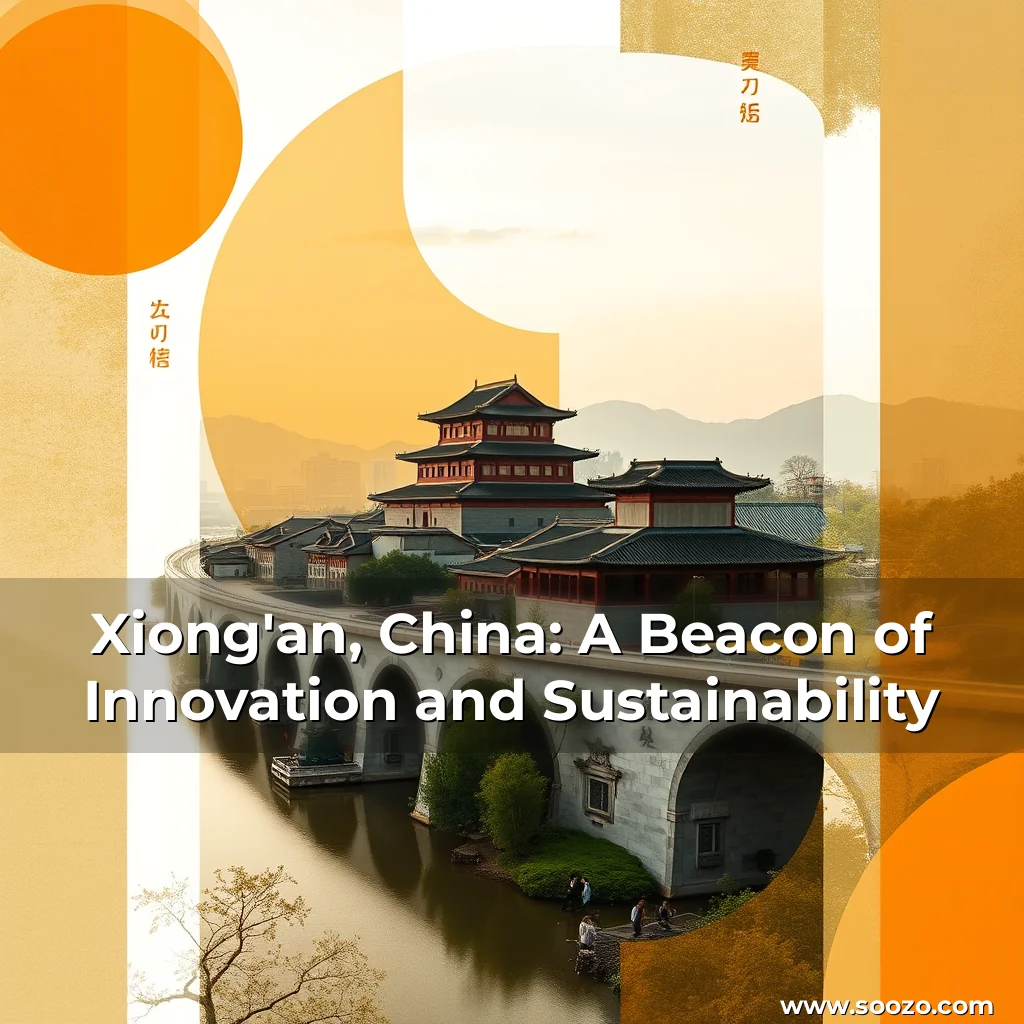
Xiong’an, a new city in Hebei Province, China, has been making headlines with its rapid transformation into a futuristic hub for innovation and sustainability. Located about 100 kilometers southwest of Beijing, the city has been designed to relieve the nation’s capital of non-essential functions while promoting the coordinated development of the Beijing-Tianjin-Hebei region.
The Xiong’an New Area was established on April 1, 2017, with a focus on accelerating relocation efforts and promoting high-quality development, high-standard management, and coordinated, efficient resettlement. The city has entered a pivotal stage, where large-scale infrastructure projects are advancing in tandem with accelerated relocation efforts.
Major breakthroughs have been made in the area of industrial development, with the presence of several state-owned enterprises (SOEs) driving the growth of emerging industrial clusters. These clusters span satellite internet, spatiotemporal information, aerospace vehicles, and the intelligent manufacturing of commercial satellites.
- More than 60 enterprises have been attracted to the aerospace information sector, showcasing the city’s commitment to becoming an innovation hub.
- The Xiong’an New Area has seen the successful implementation of several landmark relocation projects, with four headquarters of centrally-administered SOEs already settled in the new area.
- Over 4,000 Beijing-based enterprises have established operations in Xiong’an, and centrally-administered SOEs have opened over 300 branches and subsidiaries in the area.
Xiong’an is also focusing on sustainable development, prioritizing people in its approach to modernization and ensuring that ecological sustainability is integrated throughout the entire process. The city has implemented measures to promote high-quality development, high-standard management, and coordinated, efficient resettlement.
“We feel extremely comfortable, and our sense of happiness has greatly improved,”
said Huang Yuqiang, general manager of a tech firm, who relocated his company from Beijing to Xiong’an four years ago. His company has secured several invention patents, and its autonomous UAV inspection platform has been applied to various scenarios, including road defect inspections and park security.
Huang’s story reflects Xiong’an’s remarkable population growth, with its permanent population reaching 1.36 million by 2024. The city’s increasing appeal as a hub for talent and opportunities is evident in its ability to attract residents, including families, who are drawn to its favorable living conditions, parks, recreational facilities, schools, and convenience stores.
Designated to create favorable living conditions for residents, Xiong’an aims to dedicate only 30 percent of the city’s space to urban development, leaving the rest for water and greenery. The city has added a total of 481,000 mu (about 32,067 hectares) of trees, raising its forest coverage rate from 11 to 35 percent.
| Forest Coverage Rate | 11% (pre-2017) to 35% (2024) |
| Tree Plantations | 481,000 mu (about 32,067 hectares) |
| Water Quality | Highest level since monitoring began in 1988 |
Xiong’an’s smart mobility solutions are another notable feature, with 153 kilometers of digital roads equipped with smart lampposts that integrate traffic lights and various sensors. The intelligent system automatically adjusts signal timing to minimize red-light stops, significantly enhancing traffic efficiency.
“All these innovations have enabled residents to enjoy a higher quality of life in a smarter city,”
said Li Nan, a supervisor at Xiong’an Cloud Network Technology Co., Ltd. “At the heart of these smart systems is the Xiong’an urban computing center, often referred to as the city’s ‘brain,’ which drives the construction and management of this smart city.”
Xiong’an’s commitment to sustainability and innovation is evident in its synchronized development of both its digital and physical urban spaces on a citywide scale. The city’s smart technology is being used to tackle common urban challenges, such as overflowing trash bins and illegal parking, through the use of AI-equipped cameras and a management platform.
The Xiong’an urban computing center, or “brain,” integrates technologies such as the Internet of Things, big data, AI, and cloud computing to enable real-time, refined and intelligent urban management. This hub drives the construction and management of the city’s smart systems, ensuring a high-quality of life for residents.
As Xiong’an continues to grow and develop, it serves as a beacon of innovation and sustainability, offering a unique model for densely populated areas. Its commitment to prioritizing people and ecological sustainability is inspiring, and its smart systems are revolutionizing urban management. The city’s future looks bright, and its transformation into a futuristic hub for innovation and sustainability is a promising development for China and the world.
With its rapid transformation into a futuristic hub, Xiong’an is leading the way in sustainable development and innovation.

news is a contributor at Soozo. We are committed to providing well-researched, accurate, and valuable content to our readers.